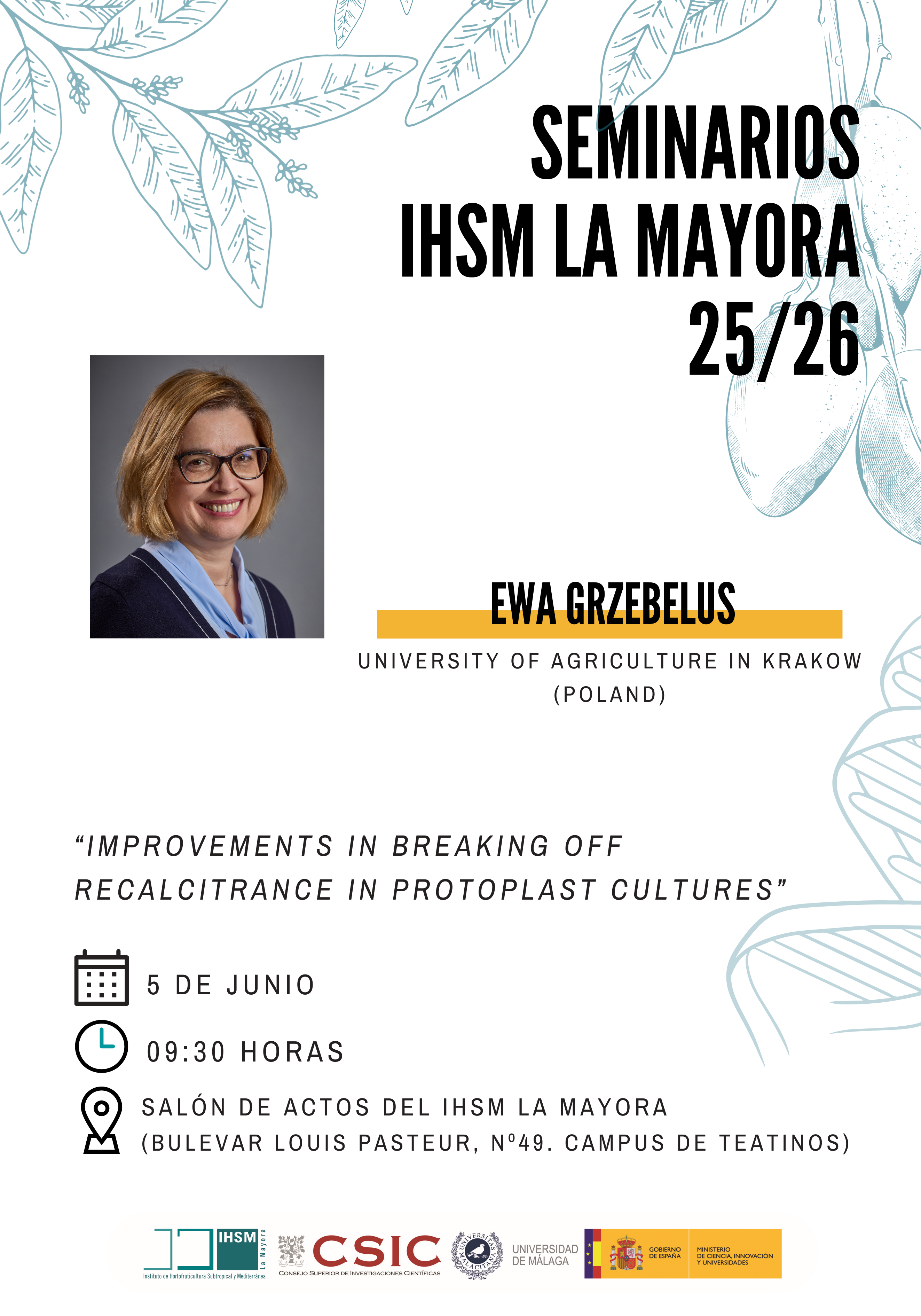
Seminarios IHSM La Mayora - Diego Orzáez (Instituto de Biología Molecular y Celular de Plantas (IBMCP), Valencia)
Synthetic Gene Circuits (SGCs) are transforming plant biotechnology by enabling precise control of gene expression, dynamic signal processing, and fine-tuned metabolic regulation. Recent breakthroughs include sensor modules responsive to chemical or electromagnetic cues, synthetic promoters coupled to programmable transcription factors, and virus-derived replicons for transcriptional amplification. This talk will present recent advances in the design of SGCs in plants, focusing on circuits that use autonomous bioluminescence as a quantitative and non-invasive output. Building on this approach, I will describe the development of autonomous viral sensing platforms that exploit recombinant plant viruses to deliver missing components of the fungal bioluminescence pathway (FBP), enabling spatially resolved imaging of infection dynamics. Expanding on this concept, our group has engineered a dual-output sentinel circuit integrating a protease-responsive Bioluminescence Resonance Energy Transfer (BRET) module. In uninfected plants, the system emits a stable yellow glow indicating circuit integrity, while infection by potyviruses triggers cleavage of the BRET fusion by the viral NIa-Pro protease, producing a distinct colour shift in luminescence detectable with low-cost imaging systems. Based on these examples, the potential of sentinel-like genetic circuits as autonomous biosensing tools for real-time monitoring of plant health and biotechnological processes will also be discussed.